1. PRO Paragraph Structures
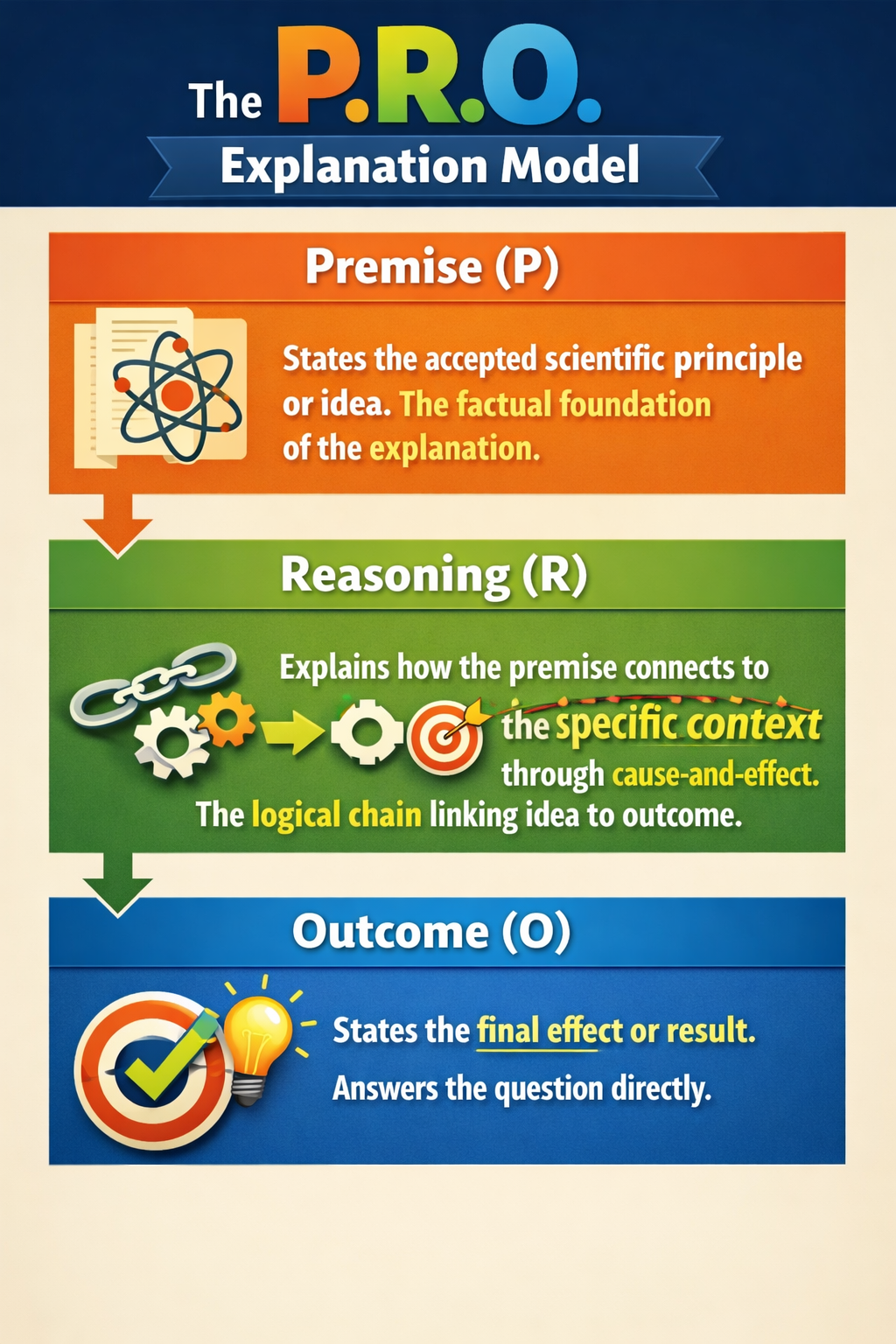
PRO (Premise-Reasoning-Outcome) paragraph structures are a common organisational pattern in scientific explanations. They consist of three main components:
Premise (P)
States the accepted scientific principle or idea that applies to the situation. This is the factual foundation of the explanation.
Reasoning (R)
Explains how the premise connects to the specific context through cause-and-effect. This is the logical chain that links the idea to the outcome.
Outcome (O)
States the final effect or result that follows from the reasoning. This completes the explanation and answers the question directly.
1.1. Worked Example: PRO Paragraph
Consider the following question that might be posed in a chemistry context:
“Explain why heating a gas causes an increase in pressure.”
Possible PRO structure:
Heating a gas increases the kinetic energy of its particles.
Reasoning: As a result, the particles move more rapidly and collide with the walls of the container more frequently and with greater force.
Outcome: Therefore, the pressure inside the container increases.
1.2. PRO Paragraph Checklist
Premise (P)
Heating a gas increases the kinetic energy of its particles.
Premise Checklist
Premise (P) - (set the situation or fact)
States a scientific fact, principle, properties, or observation
Can start with “When…”, “A…”, “The…”, or a descriptive statement
Includes the key concept for the explanation
Contains only one main idea
Does not explain why the outcome occurs yet
Test: Can you continue naturally with “As a result…”?
Reasoning (R):
As a result, the particles move more rapidly and collide with the walls of the container more frequently and with greater force.
Reasoning Checklist
Reasoning (R) - “As a result…” (explain what happens inside)
Starts with “As a result…”
Explains what is happening at a particle/process level
Clearly links back to the Premise
Uses simple action words (move, collide, separate, react)
Does NOT jump to the final outcome too quickly
May include “so…” inside the sentence if needed
Test: Does this explain HOW or WHY it happens, not just WHAT happens?
Outcome (O):
Therefore, the pressure inside the container increases.
Outcome Checklist
Outcome (O) - “Therefore…” (state the final result)
Starts with “Therefore…”
States the final observable result
Clearly answers the original question
Is short and direct
Does NOT repeat the reasoning
Does NOT include “because”
Test: Is this something you could observe or measure?