1. Accuracy and Precision
Experimental error is the difference between a measured value and the true or accepted value.
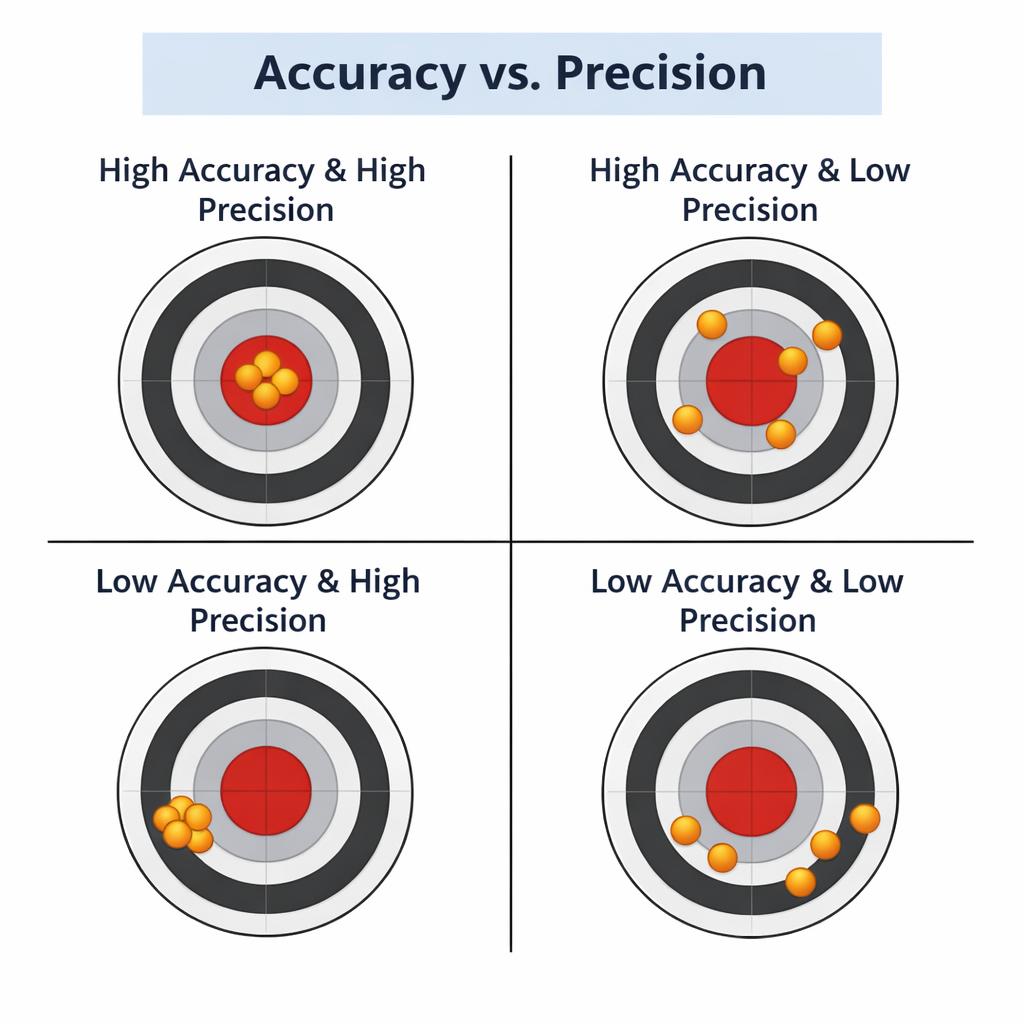
Accuracy describes how close a measurement is to the true value. A measurement with high accuracy has only a small difference from the true value.
Precision describes how close repeated measurements are to each other. A set of measurements with high precision shows very little variation between trials.
Accuracy and precision are independent. A result can be accurate but not precise, precise but not accurate, both, or neither. Understanding this distinction helps scientists evaluate the quality of their data and identify sources of error.
Fill in the Gaps — Accuracy and Precision
Complete the following by filling in the missing words.
Word list (A → Z): accuracy • high precision • low accuracy • low precision • precision
__________________ describes how close a measurement is to the true or accepted value.
__________________ refers to how close repeated measurements are to each other.
A set of results that are far from the true value shows __________________.
A set of results that are scattered and inconsistent shows __________________.
A measurement that is both correct and consistent demonstrates both high accuracy and __________________.
Reveal Answer Key
accuracy
precision
low accuracy
low precision
high precision
Multiple-Choice Questions
Choose the best answer for each question.
Which situation shows high accuracy and high precision?
a. Measurements close to the true value and close to each otherb. Measurements close to the true value but widely scatteredc. Measurements far from the true value but tightly groupedd. Measurements far from the true value and scattered
Which situation shows high accuracy but low precision?
a. Readings that average to the true value but vary widelyb. Readings that are tightly grouped but incorrectc. Readings that are both incorrect and inconsistentd. Readings that are consistently too high due to zero error
Which situation shows low accuracy but high precision?
a. A ruler with unclear markings producing scattered measurementsb. A thermometer giving random values around the true temperaturec. A balance giving both correct and incorrect readings at randomd. A faulty scale giving consistent readings that are all too high
Which situation shows low accuracy and low precision?
a. Results that are correct on average but inconsistentb. Results that are consistent but shifted away from the true valuec. Results that are neither close to the true value nor to each otherd. Results that are correct and repeatable
What type of error most often causes low accuracy but high precision?
a. Random errorb. Systematic errorc. Recording error onlyd. Environmental noise
Reveal Answer Key
a — Measurements close to the true value and close to each other
a — Readings that average to the true value but vary widely
d — A faulty scale giving consistent readings that are all too high
c — Results that are neither close to the true value nor to each other
b — Systematic error